

PORTLAND, Ore. (CN) - The call comes in just after dusk: Snowboarder overdue. Last seen by friends near the Hogsback, a wind-carved snow formation high up on Oregon's Mount Hood.
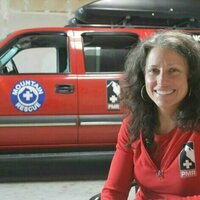
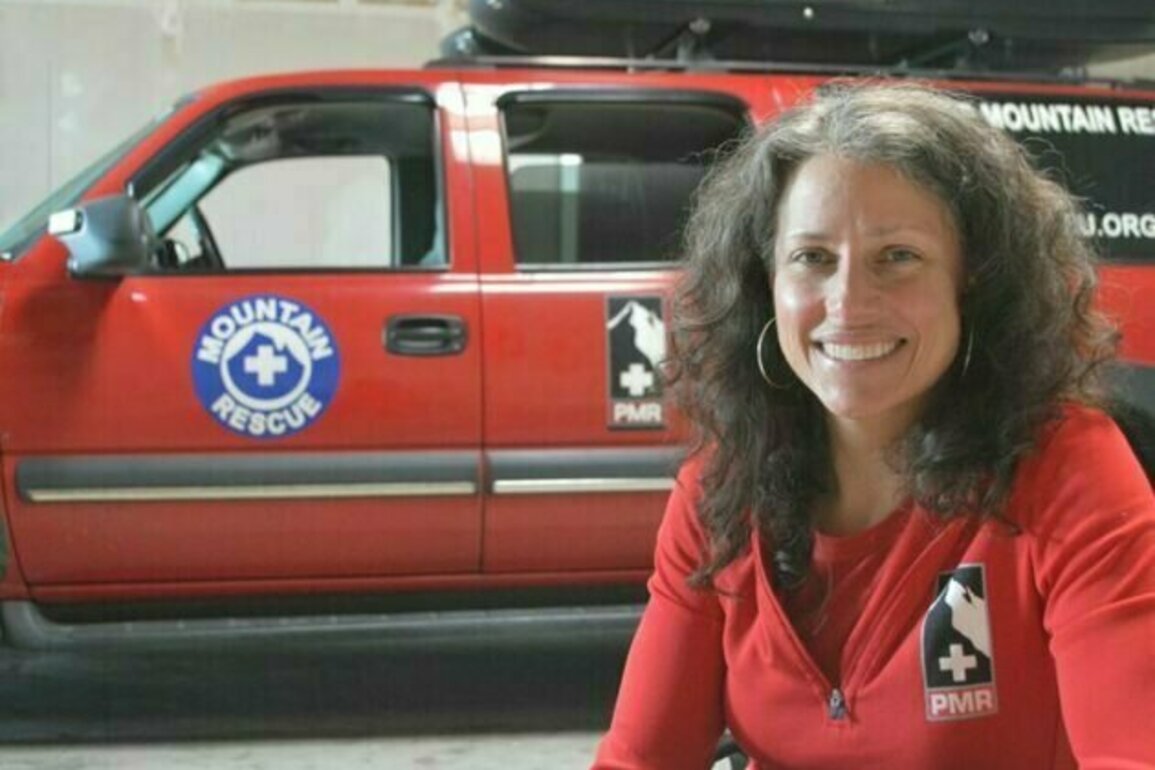
When Professor Paige Baugher catches word, she's nearly two hours from the mountain, wrapping up lesson plans and lectures for her biology class.
Baugher, with the nonprofit Portland Mountain Rescue, is just one of thousands of people across the Pacific Northwest who volunteer as search-and-rescue workers, helping keep the region's outdoorspeople safe.
From vast forests to sudden storms that bring whiteout conditions, scores of hikers, climbers and skiers every year underestimate the risk this majestic landscape can bring. But the peril is real: Out here, a simple misstep can mean a bout of hypothermia or a 500-foot fall.
Growing up in Alabama, Baugher developed a deep love for the outdoors. She took just about any opportunity to get outside, often taking family trips to canoe whitewater rapids.
Baugher moved to Oregon in 2008 to teach biology at Pacific University in Forest Grove, a small town just outside of Portland. Her outdoor hobbies soon expanded to meet the terrain. She developed a new fondness for sports like mountaineering and skiing, and with them, a deeper appreciation for wilderness safety.
"I've always been vigilant about what people are doing in the outdoors," Baugher said in an interview at the Portland Mountain Rescue headquarters, a large garage in Southeast Portland outfitted with a climbing wall.
Baugher first learned about Portland Mountain Rescue in 2016, when she saw a flyer. After rigorous training, she was recruited as a support team member in 2019.
"I realized I could actually do this in an official capacity," she said. "I think that's what attracts a lot of people, folks who've been part of the outdoor community for a long time and want to give back through education or help."
Baugher is now proud to count herself among the 120-plus volunteers that make up PMR's team, accredited by the national Mountain Rescue Association to perform high-altitude recoveries.
It's an exclusive and highly trained group. Of the people who complete the two-year training program, only about 30% to 40% are accepted, Baugher said.
Roles range from deployable rescuers to people who handle communication and coordination. Some of the most essential members rarely step into the field.
"One of the least recognized groups is our logistics team," said Jamie Reckers, vice president of Pacific Northwest Search and Rescue, another Oregon-based group. "They make sure the deployable members are ready to go, with functioning gear and everything else we depend on." On particularly long days, they might also show up with snacks and coffee to rescuers warm, fed and moving.
Together, these groups are a lifeline across thousands of square miles of Oregon public land.
They frequently collaborate, but each has its own turf. Portland Mountain Rescue or PMR handles Mount Hood's busy southside, where most climbers, snowboarders, and skiers ascend. The Crag Rats, America's oldest mountain rescue team, monitor the wilder and less-traveled north face of the mountain. Pacific Northwest Search and Rescue or PNWSAR responds to emergencies at lower elevations, focusing on the rugged forests and hills surrounding the Willamette Valley.
All of this contributes to an impressive, volunteer-driven infrastructure that's always ready when emergencies hit.
"It's a year-round endeavor," said PNWSAR President Jeff Tinnin.
Some times are busier than others - but rescue workers never know when they might be needed. "The reality is, accidents can happen any time," Tinnin said. Monthly skills sessions help them stay sharp on everything from land navigation and rope systems to even marine rescue. "You can't really let off the gas that much."
Becoming a mountain rescue worker takes big time commitments, rigorous training and incredible physical and mental resilience.
At Portland Mountain Rescue, recruits must pass through a two-year training academy. It culminates in a written exam and hands-on skills evaluation. Candidates are selected through a competitive interview process, where they're assessed on their mountaineering resumes. That includes everything from technical climbs and ski descents to avalanche knowledge and snow safety.
Even after passing that initial screening, applicants must also face a practical field test. Working under pressure, trainees need to demonstrate skills like navigation, knot-tying and rope systems. Only those who excel in every area graduate from a trainee to a support team member - the first step towards deploying for a real-world mission.
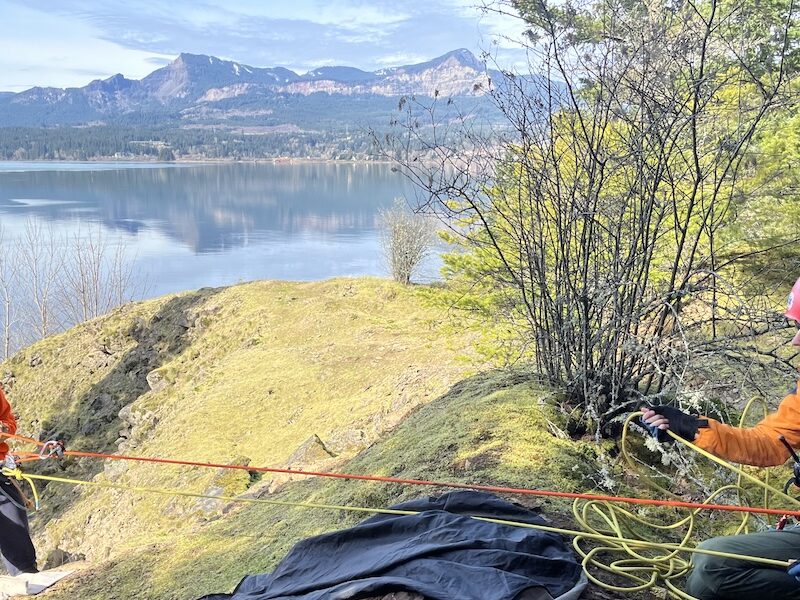
Details may differ, but all search-and-rescue groups impose similarly rigorous standards. At PNWSAR, fitness is a constant one. Volunteers log workouts and hikes on apps like Strava to prove they can meet physical benchmarks. Over just the past year, PNWSAR says its volunteers have logged more than 9,255 hours of training time in total.
At Mount Hood, rescue volume tends to peak in April and May, as warmer weather draws more people to the mountain. But rescue calls come in all year, and each one is unique.
Incidents range from injured hikers and fallen skiers to much grimmer stuff, like body recoveries and evidence searches on behalf of law enforcement. Sometimes, volunteers help search for missing elderly people.
Once a 911 call comes in, the local sheriff's office contacts the appropriate rescue organization and shares all available details. At Pacific Northwest Search and Rescue, dispatchers might start finding available responders, assigning roles and organizing logistics for needed equipment like drones or boats.
Some places are such search-and-rescue hotspots that rescuers simply wait for calls to come in. Pacific Northwest Search and Rescue stations volunteers in Hood River, a mecca for high-risk windsports like parasailing and kiteboarding in the Columbia River Gorge.
Similarly, Portland Mountain Rescue places volunteers near Mount Hood's summit during peak climbing weekends, knowing that as more people go up the mountain, accidents are statistically inevitable. They "sit there right on a snow ridge and just watch people make bad decisions," Baugher said with a dry laugh. "It's pretty fun, because we also get to just hang out up there."
As Baugher sees it, visitors often underestimate the challenge of Mount Hood. "It used to be an 'easy' mountain to climb," she said of the mountain, making air quotes around the word. But climate change has made conditions less predictable, and Oregon's booming population has led to larger crowds. Besides, as a safety-minded person, she never found the trek particularly simple. "I've climbed it dozens of times, and I could maybe say I thought it was easy, like, twice."
Once a rescue call comes in, Baugher and other responders first make their way to Mount Hood's Timberline Lodge. Sitting around the treeline at 6,000 feet, the historic lodge - famous for its appearance in Stanley Kubrick's "The Shining" - serves as the launch point for most Portland Mountain Rescue operations.
Just that first step can take several hours. That's before rescuers even start climbing. If an incident is near the summit at 11,200 feet, they still have more than 5,000 vertical feet to go.
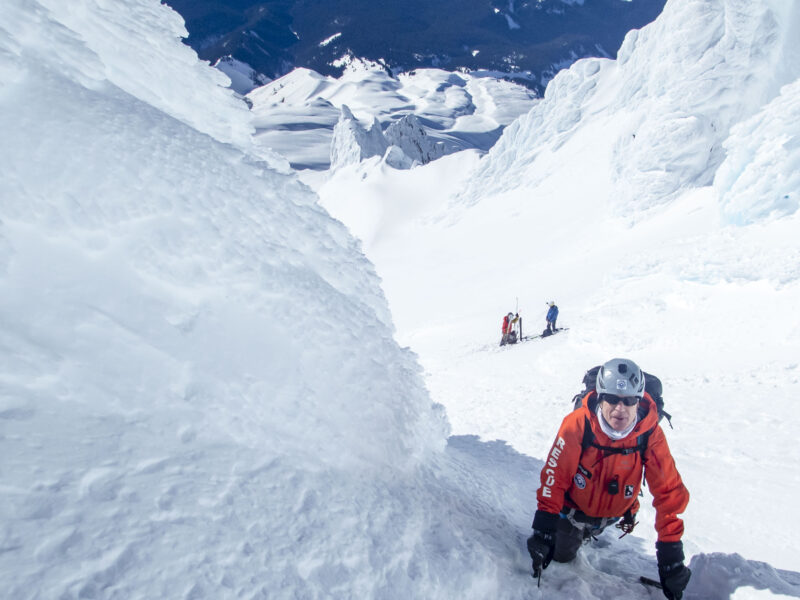
If weather allows, rescuers can use Mount Hood's ski lift. That gets them to 8,500 feet. The Timberline Lodge might also let them use its snowcats. But often and especially in poor conditions, they must simply hike to the scene. For the summit, that amounts to an exhausting six-hour climb, as volunteers lug up ice axes, medical gear and rescue equipment.

Most accidents here occur near Crater Rock, a massive outcrop just below the summit with an angle of 35 to 45 degrees. Ideally, climbers who slip in that area should dig into the snow with their axes to stop their fall. More often, people panic and slide hundreds of feet before coming to a stop.
Surprisingly, many who take this fall survive with only minor injuries.
The difference, Baugher explains, is how they fall. "If you slide, you might be OK," she says. "If you start tumbling, that's when people really get hurt. Internal injuries, head trauma, broken bones."
Baugher gets particularly nervous when she sees inexperienced people using ropes. The terrain isn't technical enough to require them, and they can even be a liability.
"If you get tangled, it can actually make it easier to fall and harder to stop," she said. But some unlucky climbers don't just fall off Mount Hood - they fall into it.
It was around 8 p.m. one January night in 2022 when Baugher arrived at Mount Hood for the snowboarder-rescue call. He'd fallen into a fumarole, a type of toxic steam-filled cave.
"He slid off the Hogsback," Baugher said. "If you slide off it in just the right place, you'll fall into Devil's Kitchen fumarole, which is exactly what happened." She added that particularly icy conditions that night had probably made it harder for the snowboarder to stop his fall.
Mount Hood is a stratovolcano. It last erupted in 1865, likely creating Crater Rock. Nonetheless, it's still active. It's riddled with steamy fumaroles, where vents of volcanic vapor melt snow from below.
Filled with gases like sulfur dioxide and hydrogen sulfide, the air in these caves can be lethal. Protective gear like goggles, respirators and air quality monitors are a necessity for any rescuer entering one.
Fumaroles are so common at Mount Hood that some - including Devil's Kitchen and Hot Rocks - are landmarks. All of them are hidden hazards, deep pits of hollowed-out snowpack waiting to swallow the unsuspecting.
In a tiny bit of good news, toxic gases in these caves often stay low to the ground. That means that if an injured climber can stay conscious with their head elevated, they can usually avoid fatal levels of inhalation.

The snowboarder was around 10,000 feet up, near the summit. His friends had seen him fall and quickly called 911. As they waited for help to arrive, the two friends built an impromptu snow cave to shield themselves from the frigid winds. They could hear his agonizing cries echoing up from the pit below.
It would be several more hours before Baugher and her team arrived. It takes time to organize teams, prepare for a rescue and then get there, Baugher said - especially in the dark. As for the snowboarder, "he fell sometime earlier that afternoon, so he was in the fumarole for around six hours or so before we were able to reach him."
When they arrived on-site around 11 p.m., the recovery itself also proved tricky. The snowboarder had a broken femur - an incredibly painful injury.
"Generally, what we want to do is just clip their harness and pull them out," Baugher explained. "He was in too much pain. His injuries were severe enough that he wasn't ambulatory."
Since the team knew the operation involved injuries, they were joined by a special type of medical rescue worker. They're known affectionately as RATs, an acronym for a reach-and-retreat team of outbound paramedics.
RATs are paramedics trained in mountain environments. They're vital in complex rescues like this one, where stabilization and pain management are critical. They can handle tasks that other workers might not be trained or even legally allowed to do. As Baugher puts it: "It's not our job to give meds."
After designing a rope system specific to this rescue, a team member suited up in protective gear and headed down into the fumarole.
"We tried to distract him, but the patient was in way too much pain," Baugher said. Another team member who works as a surgeon descended, applying a splint and loading the snowboarder into a stretcher.
Hauling him out of the 30-foot pit was only half the battle. Getting him back down the mountain took another four hours.
Baugher worked on what's known as the anchor team. As rescuers lowered the injured man down the mountain with ropes, she scurried along the steep mountain face to anchor the rope system.
In total, the rescue stretched across nine or ten hours, all of it volunteer time. The severity of the whole ordeal, coupled with the expertise required to complete it, earned Portland Mountain Rescue an award for most inspirational rescue at the 2023 Rocky Talkie Search And Rescue Awards. They shared it with the Crag Rats, who also helped in the search.
What happened next for the snowboarder? Baugher doesn't really know. While rescuers and rescuees sometimes stay in touch to mitigate trauma, it's rare for volunteers to get closure on their rescues.
Instead, they typically just drop a person or body off with the relevant friends or authorities, and that's it. No follow-up calls and no debriefing. No certainty about what followed a particularly emotional recovery operation, whether a skier's neck ever fully recovered or if the sheriff's office found the relatives of a deceased hiker.
"We often don't actually get the end of the story," said Tinnin, the PNWSAR president. "If you like closure, it can be pretty hard." He makes a point to remind volunteers that even unsuccessful searches carry meaning. Even when outcomes are tragic, their efforts still matter deeply to whoever knows that person.
Unanswered questions can build up in the form of trauma - and remember, these are unpaid volunteers. During a particularly dark period a couple years back, Tinnin said his group was asked to handle a string of body-recovery operations, including back-to-back-to-back suicides in the woods. Even for rescue workers used to gore and gruesome accidents, these suicides were particularly hard.
Following these difficult jobs, the organization developed a culture of supporting volunteers with tools for emotion management. Working with the Responder Alliance, a nonprofit focused on mental-health needs for first responders, PNWSAR now uses what it calls the 3-3-3 model, checking in on first responders three days, three weeks and three months after a traumatic event.
"We try to provide, as we come across them, resources that are geared toward emergency responders," Tinnin says. He noted that while emergency responders like cops and EMTs might have access to on-the-job mental health care services, volunteers didn't always have that kind of access.
Despite the long hours, dangerous conditions and emotional weight, volunteers like Baugher keep showing up.
"I've spent a lot of time in the mountains since I've been here," she said in an interview. "I just feel like I can give back. That's what a lot of people would say. It's a way that they can give back to a community that they really care about."
"I like helping people, and I feel like I'm making a difference in other people's lives," she continued. "Even if it's a search - because we go on a lot of searches where we don't find people."
A couple years back, she helped look for a person who was lost in the Columbia River Gorge. They searched for five days, with no luck.
"It was five days of just, like, grid searching," she said. "Looking under logs - and you just don't find people." She paused a minute, reflecting on that search. "They're still important, even if you don't ever find them."

Source: Courthouse News Service